

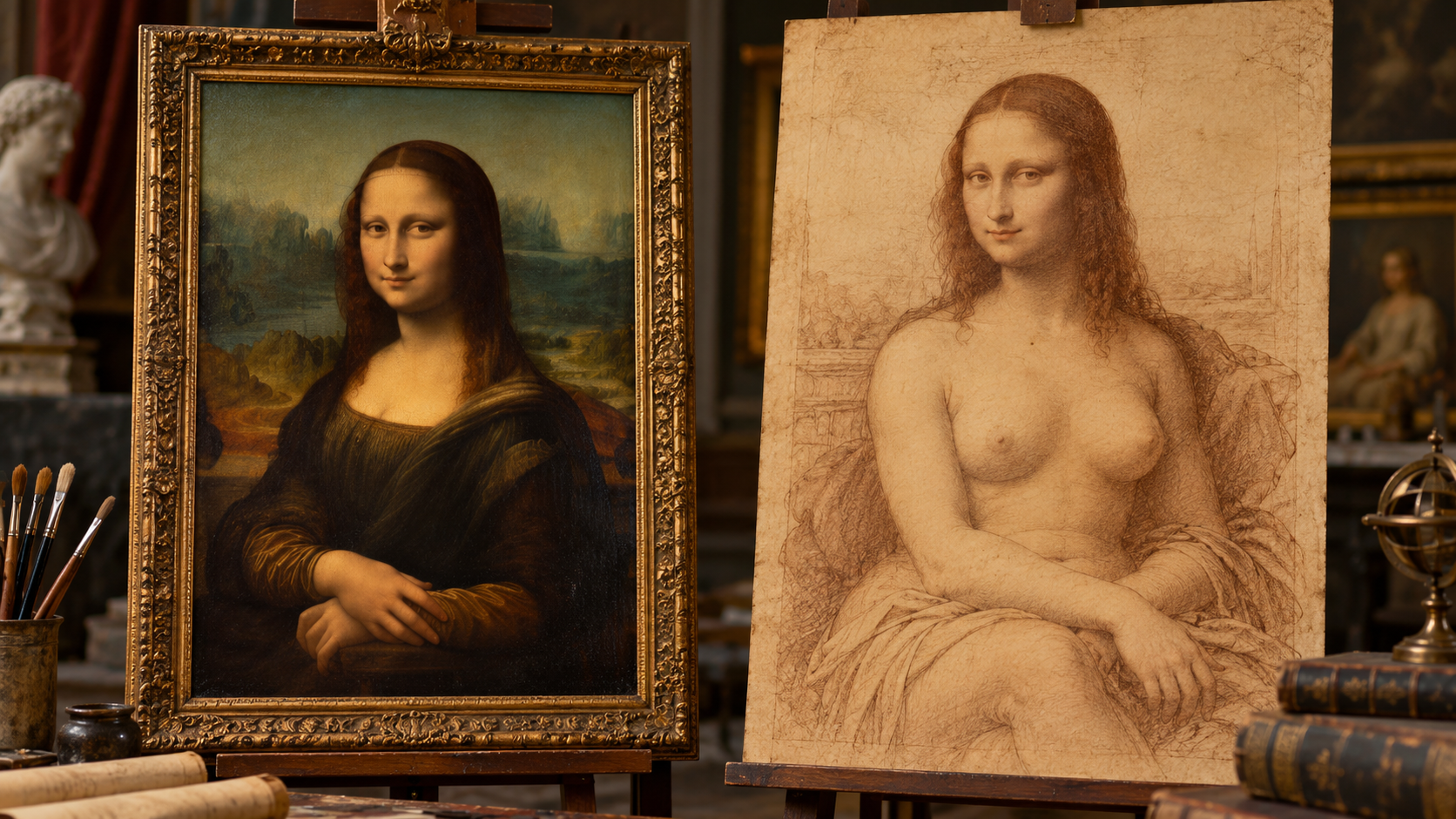
The Mona Lisa is one of the most recognizable paintings in the world, admired for its mysterious smile and extraordinary artistic detail. However, another fascinating subject has attracted the attention of art historians and curious viewers: Mona Lisa naked. This intriguing topic connects to a historical drawing that may reveal another side of Leonardo da Vinci’s artistic legacy.
What Is the Mona Lisa Naked Artwork?
The term “Mona Lisa naked” is commonly associated with a Renaissance drawing known as the Monna Vanna. This artwork portrays a partially nude woman whose pose and facial expression resemble those of the famous Mona Lisa.
The drawing is held at the Musée Condé in Chantilly, France. Although its exact authorship remains debated, researchers have investigated its possible connection to Leonardo da Vinci and his workshop.
Unlike the original Mona Lisa, which presents a fully dressed woman against a beautiful landscape, the Monna Vanna emphasizes the human figure and anatomical detail.
Did Leonardo da Vinci Create a Naked Mona Lisa?
One of the biggest questions surrounding the Mona Lisa naked drawing is whether Leonardo himself created it.
Art historians have examined the drawing’s materials, technique, and composition to understand its origins. Some evidence suggests that Leonardo may have contributed to the artwork, while other elements could have been completed by members of his workshop.
Leonardo was famous for studying human anatomy, natural beauty, and realistic proportions. His artistic investigations make the existence of a nude figure related to the Mona Lisa particularly interesting.
However, there is no definitive proof that the drawing represents the same woman who posed for the original painting.
Differences Between the Mona Lisa and Monna Vanna
Although these artworks share noticeable similarities, their artistic purposes appear different.
The original Mona Lisa is celebrated for its subtle expression, atmospheric background, and innovative painting techniques. Leonardo used sfumato, a method of blending tones smoothly to create realistic transitions between light and shadow.
The Monna Vanna, meanwhile, focuses more directly on the human body. Its composition resembles the Mona Lisa, but the figure’s clothing and presentation are significantly different.
These similarities have encouraged researchers to explore whether the drawing was a preparatory study, an independent composition, or a workshop interpretation.
Why Is Mona Lisa Naked So Popular?
Interest in Mona Lisa naked continues because the subject combines artistic mystery, Renaissance history, and one of the world’s most famous paintings.
People are naturally curious about lesser-known works associated with legendary artists. The possibility that Leonardo explored an alternative version of his masterpiece adds another dimension to his creative reputation.
The drawing also highlights how Renaissance artists studied anatomy and experimented with different representations of the human figure.
Final Thoughts
The story behind Mona Lisa naked is more than an unusual artistic curiosity. It offers an opportunity to explore Leonardo da Vinci’s creative methods and the continuing research surrounding Renaissance masterpieces.
While the exact relationship between the Monna Vanna and the original Mona Lisa remains uncertain, the drawing continues to fascinate historians and art enthusiasts.
Ultimately, this mysterious artwork reminds us that even the most familiar masterpieces can hold unexpected connections to the past.
